Google Is Auto-Upgrading Search Campaigns to AI Max. That Does Not Make It Your Media OS.
Google is flipping eligible Search campaigns to AI Max whether you asked for it or not. That is not a rumor from a reseller blog. It is Google's own product timeline. Campaigns using Automatically Created Assets and the campaign-level broad match setting are being auto-upgraded through September 2026. Dynamic Search Ads get more time. Their automatic move was pushed to February 2027 after advertisers pushed back.
The industry will treat this as a feature launch. It is actually a control transfer. Google is collapsing more of Search into a black-box optimizer that grades its own homework. If your only response is to turn every AI Max toggle on, you have accepted Google's objective as the business objective.
And: Google Made the Move Official
On the Google Ads blog, Director of Product Management Brandon Ervin described AI Max as the next generation of Dynamic Search Ads: an optimization layer on existing Search campaigns, not a new campaign type.
The June 11, 2026 update is the version that matters this month:
- Automatically Created Assets (ACA) campaigns and campaigns using the campaign-level broad match setting continue to auto-upgrade starting in September 2026.
- Google says it expects those upgrades to conclude by the end of September.
- Dynamic Search Ads sunset and auto-upgrade now begin in February 2027, after advertisers asked for more time.
- Google will not allow new DSA campaign creation via the Google Ads UI, Editor, or API once that later cutover lands.
Google's own performance claim, from internal 2026 data on non-retail advertisers, is that AI Max Search campaigns using the full suite (search term matching, text customization, and final URL expansion) see an average of 7% more conversions or conversion value at a similar CPA or ROAS than search term matching alone. That is Google measuring Google, inside Google.
What the auto-upgrade actually turns on depends on the legacy setup:
| Legacy setup | What Google says AI Max enables by default |
|---|---|
| Automatically Created Assets | Search term matching and text customization |
| Campaign-level broad match | Search term matching |
| Dynamic Search Ads (February 2027 auto-upgrade) | Search term matching, text customization, and final URL expansion, with legacy URL controls preserved |
That table is the story. Google is not asking whether expanded matching is good for your blended acquisition cost. It is asking whether expanded matching is good for Google Search.
But: Platform AI Still Optimizes the Platform
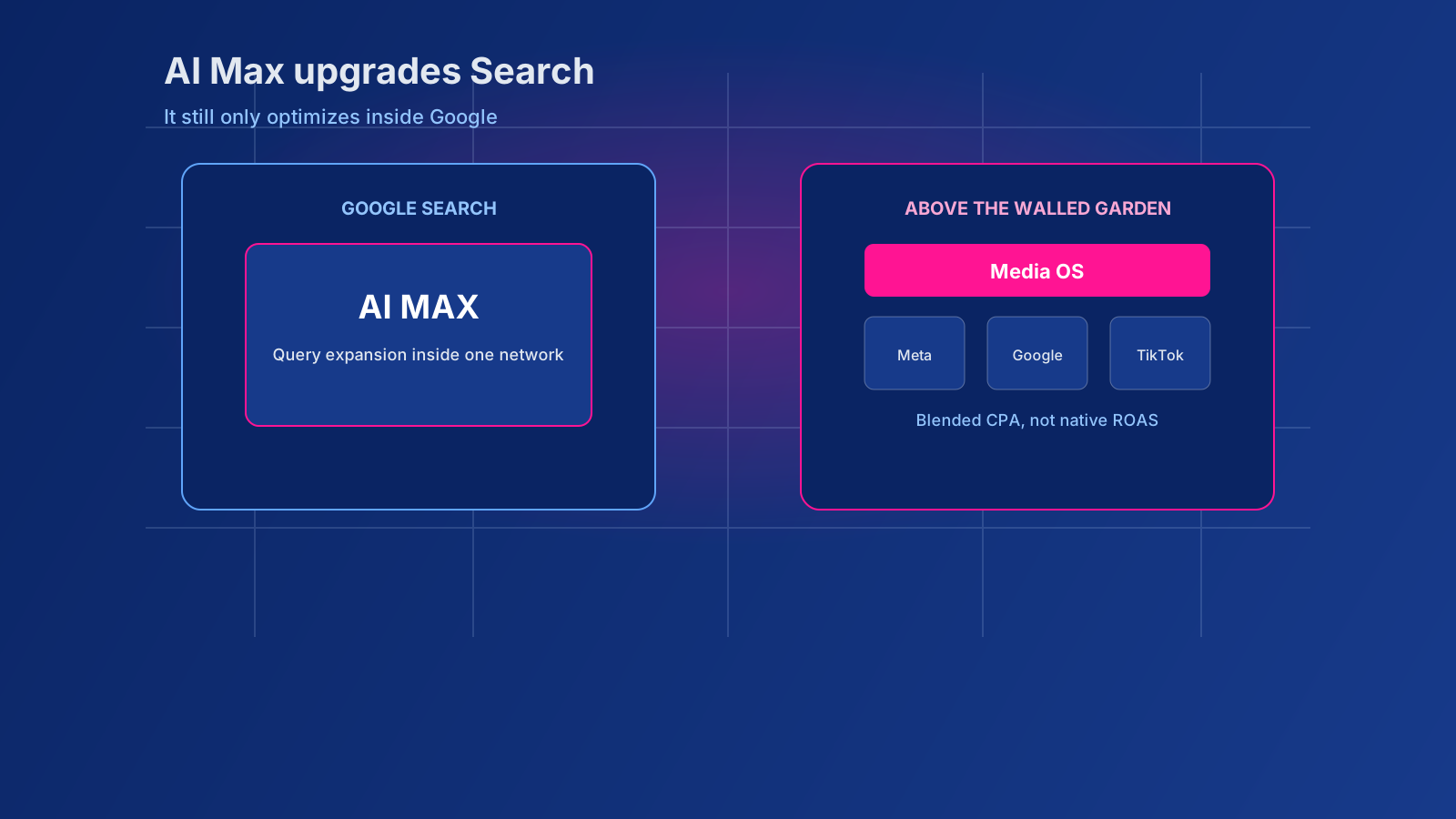
AI Max can find more queries. It can rewrite headlines. It can, if you let it, expand final URLs. None of that answers the only question that matters at the business layer: should the next dollar stay in Google at all?
This is the same structural limit as Performance Max and Meta Advantage+. Each system is powerful inside its own graph. Each one will harvest easy conversions, including existing brand demand, because that is how native ROAS looks strong. None of them will recommend moving budget to a competing network.
If you want the longer version of that argument, we already wrote it: Optimizing Google Performance Max and Scaling Media ROI with Blended CPA.
AI Max does not change the architecture. It concentrates it. Search term matching treats more queries as eligible. Text customization lets Google generate copy variants you did not write. Final URL expansion can send traffic beyond the landing pages you chose. Those are reach tools. They are not a cross-channel operating system.
"Google can auto-upgrade the campaign. It cannot auto-upgrade the P&L. AI Max will find more Google queries. It will never tell you the next dollar belongs on Meta or TikTok. That call still has to sit above the walled garden."
Brandon Keenen, Co-founder and CEO, ViVV Labs
Therefore: Treat AI Max as a Channel Setting, Not a Strategy
There is a useful way to use this migration, and a lazy way.
The lazy way is to accept the pop-up, enable every feature because Google says the 7% lift comes from the full suite, and call the account "AI native." You have then handed query expansion, copy generation, and possibly landing-page selection to a system that cannot see Meta, TikTok, or LinkedIn.
The useful way is to treat AI Max as Google's Search execution layer and put guardrails around it:
1. Inventory what is being flipped. List Search campaigns still on Automatically Created Assets or campaign-level broad match. Those are the September auto-upgrades. DSA is a separate, later event. Do not mix the two timelines.
2. Decide which AI Max features you actually want. Search term matching, text customization, and final URL expansion are different risk levels. Google's default for ACA is the first two. Final URL expansion is the most aggressive. Mirror your brand, location, and URL controls on purpose. Do not inherit them by accident.
3. Measure the business, not Google's ROAS. Native conversion value can rise while blended CPA gets worse, because Search is claiming credit for demand you already owned. Use total media spend across Meta, Google, TikTok, and LinkedIn against total business conversions. That is the blended CPA signal.
4. Keep a human on major budget shifts. Read-only monitoring can detect when Search is harvesting brand queries or when expanded matching is cheap but incremental. Named strategists should still validate moving spend, changing landing-page scope, or raising budgets. Google will not do that job for you.
| Question | Google AI Max | ViVV Operating System |
|---|---|---|
| Where does it optimize? | Inside Google Search | Across Meta, Google, TikTok, and LinkedIn |
| What is success? | Native conversions and ROAS | Blended CPA and business incrementality |
| Who writes the copy? | Advertiser assets plus optional text customization | Playbooks plus senior creative direction |
| Who moves the budget to another network? | Nobody. It cannot. | Strategists, after IIM forecasts the shift |
| Can you see the decision? | Limited Search reporting | Glass Box logging of what ran and why |
Q: Is Your Search Account Being Upgraded, or Is Your Strategy?
If Google auto-upgrades the campaign and nothing else in your stack changes, you have more automation and the same silo.
Check three things this week. Which Search campaigns still sit on Automatically Created Assets or campaign-level broad match? Which AI Max features are on after the flip, including search term matching and text customization? Are you judging the result on Google's ROAS, or on blended CPA across the account?
AI Max is a real product. It is also still Google's product. A media operating system has to sit above it: read-only telemetry, Integrated Impact Modeling before a significant budget move, Glass Box logging, and named strategists who can send the next dollar somewhere Google would never suggest.
Source: Google Ads, Dynamic Search Ads are upgrading to AI Max (updated June 11, 2026).
If you want to go deeper, read Optimizing Google Performance Max, Scaling Media ROI with Blended CPA, and Manus vs Claude Code vs Agentic Marketing.
About ViVV Labs
ViVV Labs is an Autonomous Media Agency. Senior strategists set the direction. The Glass Box Autonomous Engine executes across Meta, Google and TikTok with full decision transparency. Intake is selective and case-by-case.