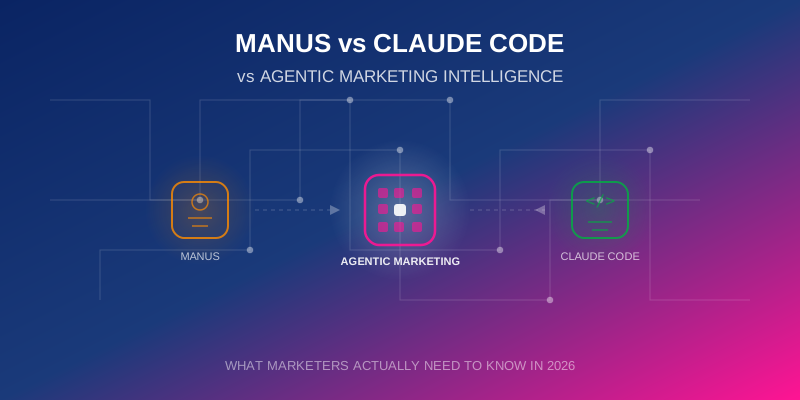
Manus vs Claude Code vs Agentic Marketing: What Marketers Actually Need to Know in 2026
The Question Everyone Is Asking
Can Manus or Claude Code run my marketing?
The short answer: they can assist with parts of it. They cannot run it.
Manus is a general-purpose autonomous agent that can browse the web, write code, book flights and create reports. Claude Code is Anthropic's developer-focused coding agent that can build software, debug systems and execute complex technical tasks autonomously. Both are genuinely impressive. Both represent a real step forward in what AI agents can do.
But marketing is not a general-purpose problem. It is a domain-specific orchestration challenge that requires specialized agents, proprietary execution data and closed-loop learning across live campaigns. That is a fundamentally different architecture.
This post breaks down what Manus and Claude Code actually do, where they fall short for marketers, and what a purpose-built agentic marketing system delivers that horizontal tools cannot.
What Is Manus and What Does It Actually Do?
Manus is a general-purpose autonomous AI agent built to complete multi-step tasks across the open internet.
- Browses websites, extracts data and compiles research autonomously
- Executes sequences of actions without human intervention between steps
- Handles tasks like travel booking, competitive research, report generation and data analysis
- Works across any domain with no specialization in any single one
- Launched in early 2025 with significant attention for its ability to chain complex actions together
Manus is designed to be broad. That is its strength and its limitation. It can do a lot of things reasonably well. It cannot do one thing at the depth required for compounding performance.
What Is Claude Code and What Does It Actually Do?
Claude Code is Anthropic's autonomous coding agent designed to handle complex software engineering tasks end to end.
- Writes, debugs and refactors code across multiple languages and frameworks
- Navigates large codebases, understands context and makes architectural decisions
- Executes terminal commands, runs tests and manages git workflows autonomously
- Built specifically for developers who need an AI partner inside their development environment
- Represents Anthropic's push into agentic tool use beyond conversational AI
Claude Code is vertical and deep within its domain. It is purpose-built for software engineering. That is exactly why it works well. The same principle applies to marketing, but the tools do not exist yet at this level of depth. Until now.
Why Neither Tool Can Run Your Marketing
Marketing is not a single task. It is a system of interdependent decisions that must execute, measure and retrain continuously across multiple channels simultaneously.
| Capability | Manus | Claude Code | Purpose-Built Agentic Marketing System |
|---|---|---|---|
| Can write ad copy | Yes, generic | Yes, generic | Yes, trained on performance data from live campaigns |
| Can allocate budget across channels | No | No | Yes, with predictive modeling before budget moves |
| Can optimize campaigns in real time | No | No | Yes, continuous closed-loop optimization |
| Can attribute results across platforms | No | No | Yes, platform-agnostic attribution that feeds signal back into every agent |
| Can learn from past campaign performance | No persistent memory | No persistent memory | Yes, compounding intelligence across every client and every campaign |
| Can coordinate strategy, creative, audience, budget and analytics simultaneously | No orchestration layer | No orchestration layer | Yes, Master Agent coordinates nine specialized agents |
| Domain specificity | Horizontal, all domains | Vertical, software engineering | Vertical, marketing execution |
| Compounds over time | No | No | Yes, every campaign makes the system smarter |
"Foundation models like Claude are the electricity. General agents like Manus are the extension cord. We are the factory built on top of both. Electricity is necessary but not sufficient. You need architecture, specialization and proprietary data to turn raw intelligence into compounding performance."
Brandon Keenen, Co-founder and CEO, ViVV Labs
What Marketers Actually Need: The Agentic Marketing Architecture
An agentic marketing system is a coordinated network of specialized AI agents, each handling a distinct marketing function, orchestrated by a Master Agent that maintains state awareness across all active campaigns.
This is fundamentally different from asking a general-purpose agent to help with marketing. Here is what the architecture looks like:
- Strategy Agent handles long-range planning, positioning and go-to-market logic
- Planning Agent handles campaign structure, timeline orchestration and resource allocation
- Optimization Agent handles continuous performance tuning across all active campaigns
- Creative Agent handles performance analysis, creative scoring and recommendation
- Analytics Agent handles unified reporting, insight generation and pattern detection
- Forecasting Agent handles predictive outcome modeling before budget moves
- Budget Agent handles cross-channel allocation and autonomous rebalancing
- Audience Agent handles segmentation, targeting and lookalike modeling
- Attribution Agent closes the loop by feeding performance signals back into every other agent
- Master Agent orchestrates all nine agents, resolves conflicts between channel-level recommendations and enforces budget constraints
Each agent is a decomposed cognitive function of what a great marketing operator does. The Master Agent ensures they work as a system, not a collection of disconnected tools.
The Compounding Problem That Horizontal Agents Cannot Solve
Marketing performance is a function of three variables: data density, feedback velocity and cognitive bandwidth.
| Variable | What It Means | Horizontal Agents | Agentic Marketing System |
|---|---|---|---|
| Data density | How much signal you can extract from every campaign | Limited to what you manually feed in | Automatically ingests every data point from every channel in real time |
| Feedback velocity | How fast insights turn into actions | Requires human to interpret and act | Agents act on signals autonomously within the closed loop |
| Cognitive bandwidth | How many simultaneous decisions the system can hold | One task at a time, no cross-task awareness | Nine agents plus Master Agent operating in parallel with full state awareness |
Traditional agencies are capped by human bandwidth. Software tools increase data density but do not reason. General-purpose AI agents like Manus increase speed but lack domain-specific architecture. None of them compound.
A purpose-built agentic marketing system combines all three variables. Every campaign generates signal. Every signal retrains the system. Every client interaction improves collective intelligence. The longer the system runs, the wider the performance gap between the system and any team operating on human bandwidth alone.
"The real question is not whether AI can help with marketing. It obviously can. The question is whether your AI compounds. If every campaign you run makes the next one smarter, you are building an asset. If every campaign starts from zero, you are renting a tool."
Brandon Keenen, Co-founder and CEO, ViVV Labs
When Should You Use Manus or Claude Code for Marketing?
Both tools have legitimate use cases for marketers. The key is understanding where they add value and where they hit a ceiling.
Use Manus when you need:
- Quick competitive research across multiple websites
- One-off data extraction and report compilation
- Ad hoc task automation that does not require marketing domain knowledge
- Exploratory research before a campaign planning session
Use Claude Code when you need:
- Marketing technology infrastructure built or debugged
- Custom analytics dashboards or data pipelines
- Automation scripts for ad platform APIs
- Technical implementation of tracking, tagging or attribution systems
Use neither when you need:
- Autonomous campaign execution across multiple channels
- Real-time budget optimization based on live performance data
- Creative strategy informed by closed-loop performance feedback
- Cross-channel attribution that retrains agent decision logic
- A system that compounds intelligence over time
That last category is where a purpose-built agentic marketing system operates.
The Platform-Native AI Problem
Marketers also need to understand the difference between agentic marketing intelligence and platform-native AI like Meta Advantage Plus, Google Performance Max and TikTok Smart Plus.
| Dimension | Meta Advantage Plus | Google PMax | Agentic Marketing System |
|---|---|---|---|
| Optimizes across platforms | No, Meta only | No, Google only | Yes, platform-agnostic by design |
| Will recommend moving budget away from itself | Never | Never | Yes, optimizes the business not the platform |
| Learns across clients | No | No | Yes, compounding intelligence |
| Transparent decision logic | Black box | Black box | Every agent decision is explainable |
| Works alongside human expertise | Limited controls | Limited controls | Expert-guided at the strategic layer |
Meta will never tell you to move budget to TikTok. Google will never suggest you reduce Search spend and increase YouTube. These tools optimize within their own walls. An agentic marketing system sits above all platforms, loyal to the business, not to any single platform's revenue model.
"We spent years watching platforms grade their own homework. Every platform told us it was the most important one. None of them would tell us to spend less on their own platform. That conflict of interest is the gap we built ViVV to fill."
Brandon Keenen, Co-founder and CEO, ViVV Labs
What to Look for in an Agentic Marketing System
If you are evaluating agentic marketing platforms, here is what separates a real system from a wrapper with a good landing page.
- Domain-specific agents with defined responsibilities, not a single general-purpose agent doing everything
- A Master Agent or orchestration layer that coordinates agents, resolves conflicts and maintains state
- Closed-loop learning where campaign results retrain agent decision logic automatically
- Platform-agnostic execution across Meta, TikTok, Google, LinkedIn and more simultaneously
- Proprietary training data from real campaign execution, not synthetic data or public datasets
- Explainable decisions so you can see what ran, why it ran and what it delivered
- Human-in-the-loop at the strategic layer with autonomous execution beneath
- Compounding performance that measurably improves over time as the system runs
The Bottom Line
Manus and Claude Code are powerful tools. They are not marketing systems.
Manus gives you breadth. Claude Code gives you depth in software. Neither gives you the domain-specific, closed-loop, compounding architecture that modern marketing demands.
The future of marketing is not a general-purpose agent that can do everything. It is a coordinated system of specialized agents that do marketing better than any human team could at scale, while learning from every dollar deployed.
| What You Need | Best Tool |
|---|---|
| Quick research across the web | Manus |
| Build marketing tech infrastructure | Claude Code |
| Autonomous, compounding marketing execution across all channels | Purpose-built agentic marketing system |
The question is not whether AI will transform marketing. It already is. The question is whether the AI you choose compounds, or whether you start from zero every time.
About ViVV Labs
ViVV Labs is an Autonomous Media Agency. Senior strategists set the direction. The Glass Box Autonomous Engine executes across Meta, Google and TikTok with full decision transparency. We work with a small number of brands per quarter through selective intake.