Does New York's AI Disclosure Law Hurt Small Business? What S8420A Really Means for Marketers
Does New York's AI Disclosure Law Hurt Small Business? What S8420A Really Means for Marketers
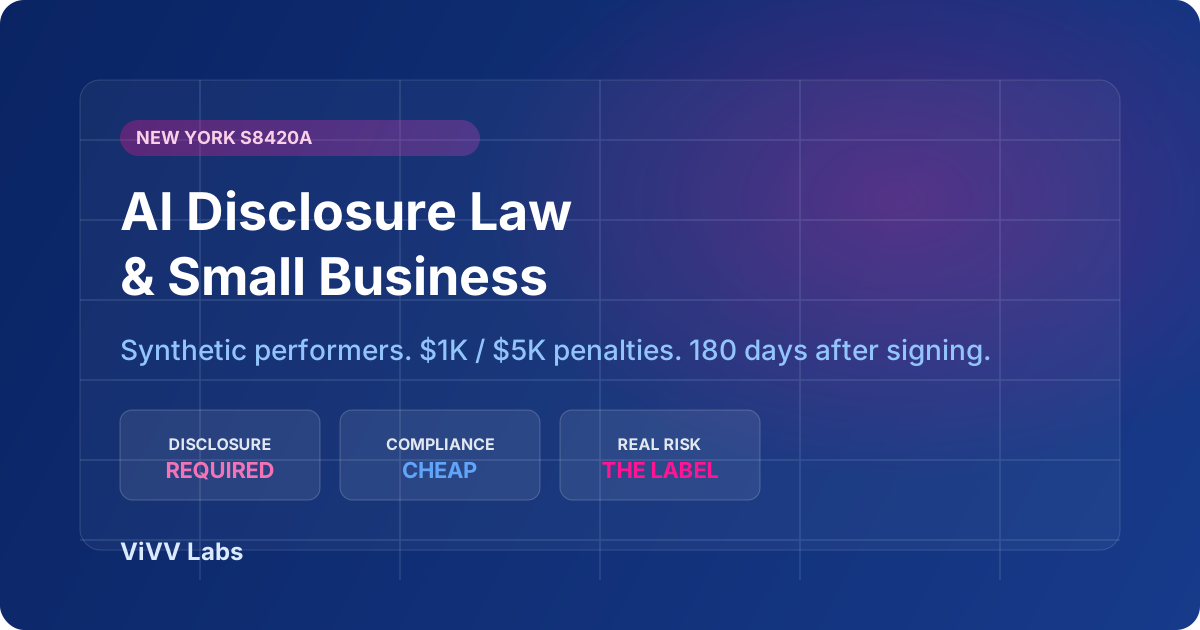
Quick answer: New York Senate Bill S8420A, signed by the Governor in the 2025-2026 legislative session, requires advertisers to conspicuously disclose when their content uses a "synthetic performer": a digitally created asset, per Section 396-b(1)(c), that uses generative AI or a software algorithm to appear as a human performer not recognizable as any identifiable natural person. The penalty is $1,000 for a first violation and $5,000 for each one after, per Subdivision 3. Compliance is cheap. The real risk is downstream: if consumers learn to flinch at the "AI-generated" label, the small businesses that AI was supposed to empower will be the first to lose ground. The law takes effect 180 days after signing.
Official source: NY State Senate Bill 2025-S8420A (amends General Business Law § 396-b). Assembly companion: A8887.
What New York's AI Disclosure Law Actually Requires
Per the signed bill text, S8420A amends Section 396-b of New York's General Business Law. Here is what marketers need to know:
- Applies to any person engaged in dealing in property or services who, for a commercial purpose, produces or creates an advertisement in any medium in which the ad appears
- Defines a synthetic performer as a digitally created asset created, reproduced, or modified by computer using generative AI or a software algorithm, intended to create the impression that the asset is engaging in an audiovisual and/or visual performance of a human performer who is not recognizable as any identifiable natural performer
- Requires conspicuous disclosure in the advertisement that a synthetic performer is present, where the advertiser (or its agent or employee) has actual knowledge
- Imposes a $1,000 civil penalty for a first violation and $5,000 for any subsequent violation
- Exempts, per Subdivision 4, advertisements and promotional materials for expressive works (motion pictures, television programs, streaming content, documentaries, video games, and similar audiovisual works) when the synthetic performer's use in the ad is consistent with its use in the work
- Exempts, per Subdivision 7, audio advertisements and ads where AI is used solely for language translation of a human performer
Who Wins and Who Loses Under S8420A
| Business Type | Compliance Cost | Real Risk |
|---|---|---|
| National brands | Low: legal teams ready | Low: can pivot to human talent if labels hurt |
| Mid-market companies | Low | Moderate: labels may dent ad performance |
| Small businesses | Low | High: AI is the budget equaliser; labels may scare consumers off |
| Hollywood studios | Low | Moderate: expect definitional fights over CGI vs. synthetic performer |
| Independent creators | Low | High: heavy AI reliance, thin margins for consumer pushback |
A Champion of Small Business Weighs In
"Disclosure laws sound reasonable on paper, but the cost of compliance isn't the issue. It's the cost of the label. AI is the great equaliser for small business. It lets a five-person team produce work that used to require a full agency. If consumers learn to flinch at the word 'AI,' you've just handed the giants their moat back."
Brandon Keenen, CEO, ViVV Labs
Will This Go the Way of GPTZero?
GPTZero failed because AI detection is a losing arms race. Every detector is obsolete the moment the next model ships. S8420A sidesteps that problem entirely. It doesn't depend on detection. It puts the disclosure burden on the advertiser. Enforcement looks more like FTC sponsored-content rules: complaint-driven, audit-based, not algorithmic.
So the "AI will get undetectable" argument isn't the loophole it appears to be. The harder question is enforcement reach. New York can fine New York advertisers. The internet doesn't respect state lines, and a $1,000 penalty isn't going to keep general counsel up at night.
The Hollywood Loophole
The law targets "synthetic performers": digital assets meant to pass as human. That definition is going to get litigated. A CGI dragon isn't a synthetic performer. A de-aged Harrison Ford arguably is. A deepfaked spokesperson definitely is. Studios will spend the next few years pushing the line around in ways small businesses can't afford to follow.
The Real Tension: What Consumers Say vs. What They Do
Consumers say they want to know when something is AI. They also want personalised, polished, on-demand content. Those preferences are in conflict, and revealed preference usually wins. Entertainment beats principle. The open question is whether a label in the corner of a video meaningfully changes behavior, or whether it fades into background noise the way "this post contains affiliate links" did within about six months of becoming mandatory.
What Small Businesses Should Do Right Now
- Audit any New York-facing advertising that features AI-generated talent before the law's effective date (180 days after signing, per Section 3 of S8420A)
- Add disclosure language to standard ad templates now, not after the first complaint
- Treat the label as a creative opportunity. Frame it as transparency, not apology
- Watch the definitional fights closely; what counts as a "synthetic performer" will shift
- Don't pull back on AI use. Pull forward on AI literacy
For teams already using AI across paid media, the operational question is how disclosure interacts with creative velocity. Read Can AI Actually Run My Paid Ad Campaigns in 2026? for where execution layers and compliance requirements meet.
Frequently Asked Questions
What is New York Senate Bill S8420A? A 2025 law, signed by the Governor, amending Section 396-b of New York's General Business Law. It requires advertisers to conspicuously disclose when their advertisements feature a synthetic performer. Read the official bill text.
What is a synthetic performer under New York law? Per Section 396-b(1)(c) of the signed bill: a digitally created asset created, reproduced, or modified by computer using generative AI or a software algorithm, intended to create the impression that the asset is engaging in an audiovisual and/or visual performance of a human performer who is not recognizable as any identifiable natural performer.
What is the penalty for violating S8420A? $1,000 for the first violation. $5,000 for every subsequent violation.
Does the law apply to CGI characters in films? Only when the CGI is used as a synthetic performer designed to appear human. Pure fantasy characters likely fall outside the definition, but this will be tested.
Does this law affect small businesses more than large ones? Compliance cost is nominal for everyone. The asymmetric risk is downstream: if consumers reject AI-labeled content, small businesses lose the competitive equaliser that AI provided.
When does the law take effect? Per Section 3 of S8420A, the law takes effect 180 days after it became law. The bill status is signed by the Governor. Businesses advertising in New York should treat preparation as urgent.
The Final Word
New York drew a line. It's a modest one: small fines, narrow scope, easy to comply with on paper. But the cultural signal is louder than the statute itself. The law isn't the threat. The market reaction to the label is. And small business is going to feel it first.
Source: NY State Senate Bill 2025-S8420A. Statutory definitions, penalties, exemptions, and effective date are drawn from the signed amendment to General Business Law § 396-b.
For related reading on AI in marketing operations, see Digital Marketing Attribution for Small Businesses, Manus vs Claude Code vs Agentic Marketing, and The Agentic Marketing Future.
About ViVV Labs
ViVV Labs is an Autonomous Media Agency. Senior strategists set the direction. The Glass Box Autonomous Engine executes across Meta, Google and TikTok with full decision transparency. We work with a small number of brands per quarter through selective intake.