
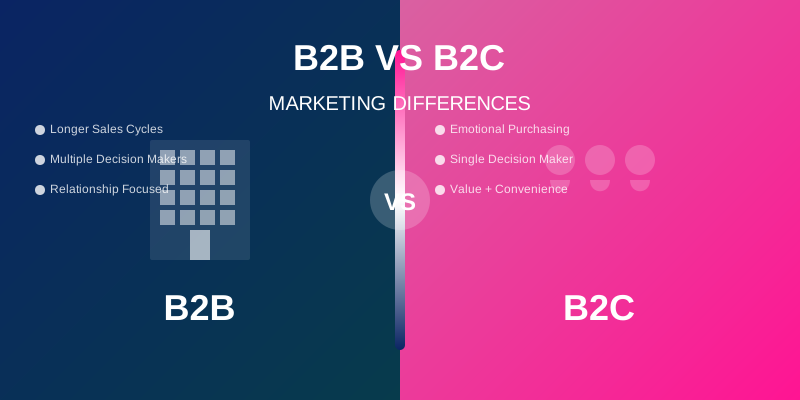
B2B vs B2C Marketing: Understanding the Key Differences
B2B vs B2C Marketing: Understanding the Key Differences
Answer: Why Do B2B and B2C Marketing Need Different Strategies?
B2B and B2C marketing represent fundamentally different buying contexts: who decides, how long it takes, what drives the decision, and how big the audience is. Despite occasional efforts to blend the two ("It is all just human to human"), treating them the same leads to misaligned channels, content, and measurement. Recognising the differences is crucial for marketing success.
In short: B2B is typically committee-driven, long-cycle, logic-justified, and narrow-audience; B2C is individual or family, short-cycle, emotion-led, and mass-audience. Your strategy should match your dominant model. The sections below break down each dimension and what it means for how you plan, execute, and measure.
Bullets: Buying Process and Decision Makers
In B2B, purchase decisions typically involve multiple stakeholders; in B2C, the buyer is usually an individual or a small group. That single difference shapes content, channels, and sales involvement.
- B2B: Purchase decisions usually involve multiple stakeholders (often 6-10 according to research). The end user cares about functionality and ease of use, IT about security and integration, procurement about cost and terms, the executive sponsor about business impact and ROI. This committee-based approach creates a complex buying journey with multiple decision gates and potential veto points.
- B2C: Decisions are mostly individual or small family units. Criteria are more personal, emotional, and less structured. Even for considered purchases, the path is shorter and the number of people in the decision is smaller.
- Implication: B2B marketers must create content and campaigns that address multiple personas simultaneously while keeping a cohesive narrative. B2C marketers can focus on trigger points for the individual decision-maker.
Bullets: Sales Cycles and Timing
How long it takes to close a deal determines what marketing must do: nurture over months or convert at the moment of intent.
- B2B: Enterprise sales cycles often stretch from 3-12 months or longer, involving multiple meetings, demos, proposals, negotiations, and approvals. The marketing team must support prospects through this extended journey, maintaining engagement and momentum and staying in lockstep with sales.
- B2C: Many purchases happen in minutes or hours. Even considered purchases such as cars or luxury goods typically conclude within days or weeks. The marketing focus is on discovery, desire, and reducing friction at the point of purchase.
- Implication: B2B marketing requires sophisticated lead nurturing, content for each stage of the journey, and tight coordination with sales. B2C can focus more on immediate conversion optimisation and making the path to purchase as smooth as possible.
Bullets: Purchase Motivation
What motivates the buyer shapes the content you create and the proof you need to provide.
- B2B: Emotions play a role, but B2B purchases must be justified with business logic. Buyers need to demonstrate ROI, competitive advantage, or risk reduction. That creates demand for detailed content: case studies, white papers, ROI calculators, and technical documentation. The sale has to survive internal scrutiny.
- B2C: Consumer purchases are driven primarily by emotional benefits (status, belonging, pleasure, convenience), even when buyers later rationalise with logic. The "why" often precedes the "what" in consumer decision-making.
- Implication: B2B marketing must balance emotional appeal (to drive interest) with substantial logical evidence (to facilitate approval). B2C can lead more heavily with emotional appeals, with supporting logic as a secondary layer.
Bullets: Audience Scale and Reach
The size of your addressable market determines how you spend: depth per prospect vs breadth of reach.
- B2B: Many B2B companies have a defined total addressable market measured in thousands or tens of thousands of potential customers. Some highly specialised B2B firms have fewer than 1,000 potential clients worldwide. Every prospect is valuable, so investment per account can be high.
- B2C: Consumer brands typically target audiences measured in millions, with broad demographic and psychographic variety. Reach and efficiency metrics take priority; you cannot afford to treat every consumer like a named account.
- Implication: B2B marketing can afford to be more targeted and personalised, with higher investment per prospect. B2C requires broader reach and scale, with efficiency metrics taking priority over depth of engagement per person.
Table: B2B vs B2C at a Glance
| Dimension | B2B | B2C |
|---|---|---|
| Decision maker | Committee (6-10 stakeholders) | Individual or small group |
| Sales cycle | 3-12+ months | Minutes to weeks |
| Primary motivation | Logic, ROI, risk reduction | Emotion, identity, convenience |
| Audience scale | Thousands to tens of thousands | Millions |
| Content focus | Case studies, ROI, technical proof | Emotion, lifestyle, immediacy |
| Channel emphasis | LinkedIn, email, events, content | Instagram, TikTok, retail, influencers, SMS |
Table: Channel Effectiveness
| Channel | B2B role | B2C role |
|---|---|---|
| Highest ROI for many; thought leadership | Limited for broad consumer reach | |
| Nurture and ongoing engagement | Promo and transactional | |
| Events / conferences | Core for relationships and deals | Less central for mass consumer |
| Instagram / TikTok | Emerging for brand and reach | Discovery and desire |
| Content marketing | Complex storytelling, proof | Short-form, shareable, emotional |
| Influencers | Niche and vertical relevance | Broad credibility and reach |
Bullets: Measurement Differences
The extended, multi-touch nature of B2B buying creates different measurement priorities than the shorter path to purchase in B2C.
- B2B: Key metrics include MQLs, SQLs, and opportunities generated; pipeline influenced by marketing; customer acquisition cost relative to lifetime value; and account engagement and penetration. Measurement requires strong integration between marketing and sales systems and often sophisticated multi-touch attribution.
- B2C: The shorter path to purchase creates different priorities: conversion rate optimisation and funnel efficiency, brand awareness and consideration, CAC relative to initial purchase value, and retention and repeat purchase rates. Simpler attribution models often suffice, with greater emphasis on incrementality testing.
- Implication: B2B measurement is about pipeline and revenue influence over time; B2C measurement is about conversion efficiency and lifetime value. Choose systems and metrics that match your buying cycle.
When the Lines Blur
Despite the differences above, we are seeing some convergence. Techniques cross over in both directions.
- B2C techniques in B2B: As B2B buyers bring consumer expectations to work, elements like personalisation, streamlined user experiences, and even influencer-style marketing are gaining traction in B2B. The bar for "this should just work" is rising.
- B2B techniques in B2C: As consumer markets become more competitive, B2C marketers are adopting account-based thinking, sophisticated content marketing, and longer-term relationship building traditionally associated with B2B. Retention and loyalty matter more when acquisition is expensive.
- B2B2C: Companies that sell to businesses but ultimately serve consumers (e.g. platforms that enable SMBs to sell to end users) must balance both B2B and B2C marketing elements in a single strategy. The buyer is a business; the end user is a consumer; both matter.
How ViVV Labs Approaches the Difference
At ViVV Labs we recognise that effective marketing measurement must account for these fundamental differences. Our platform adapts to the appropriate customer journey length (whether days or months), accounts for multiple stakeholders in B2B or individual decision-makers in B2C, and integrates with sales processes for B2B or conversion funnels for B2C. We provide attribution and measurement suited to each business model and use industry-specific benchmarks so you can compare performance against realistic standards. Respecting the unique characteristics of B2B and B2C marketing leads to more accurate measurement and more effective optimisation.
Questions: Frequently Asked on B2B vs B2C
Q: What is the main difference between B2B and B2C marketing?
B2B is typically multi-stakeholder, long-cycle, logic-justified, and smaller-audience; B2C is individual/family, short-cycle, emotion-led, and mass-audience. That drives different channels, content, and measurement.
Q: Which channels work best for B2B vs B2C?
B2B: LinkedIn, email, events, content. B2C: Instagram, TikTok, retail, influencers, SMS, push. Match channels to where your buyers decide and spend time.
Q: How do you measure B2B vs B2C marketing success?
B2B: MQLs, SQLs, pipeline, CAC vs LTV, account engagement, with strong marketing-sales integration. B2C: conversion rates, funnel efficiency, brand metrics, CAC vs first purchase, retention, often with simpler attribution and incrementality.
Q: Can B2B and B2C strategies overlap?
Yes. Techniques cross over (B2B using personalisation and UX; B2C using ABM-style and content). B2B2C companies must blend both. Your primary model should still define your core strategy and resource allocation.
Conclusion
Rather than forcing B2B and B2C into a single framework, smart marketers should recognise which model dominates their business (even companies with both B2B and B2C revenue typically have a primary orientation), build systems and processes aligned with that model instead of borrowing ill-fitting approaches from the other side, learn from cross-pollination where specific techniques can be adapted, and measure success against appropriate benchmarks rather than generic marketing standards. By embracing these differences, you can develop marketing strategies that truly align with your business reality, whether that is a complex enterprise sale or an impulse purchase at the checkout counter.


